AI Tools for University Students in Saudi Arabia: A Responsible Guide
AI tools for university students in Saudi Arabia and the Gulf: understand lectures, research with real sources, improve English writing and respect your AI policy.
The best AI tools for university students in Saudi Arabia and the wider Gulf help you understand lectures, find real sources, improve your English writing and rehearse presentations. They work well when you use them as a tutor and a practice partner, follow your university's AI policy, and never submit AI-written text as your own work.
Many programmes at Gulf universities, especially in medicine, engineering, IT and business, are taught in English, while many students think and take notes in Arabic. That bilingual reality is exactly where AI can save you hours, if you use it well.
What does your university allow?
Start here, before you open any tool. Universities across Saudi Arabia, the UAE and the rest of the Gulf have been publishing guidance on generative AI, and the rules can differ between courses in the same faculty.
- Read the syllabus and the course page for an AI policy. If there is none, ask the instructor by email and keep the reply.
- Note whether you must disclose AI use, and how (a short note at the end, an appendix, or a list of prompts).
- Never submit text written by AI as your own. Using AI to explain, quiz or give feedback is very different from using it to write for you.
- Do not use AI in exams or closed-book quizzes unless it is explicitly allowed.
- Keep your drafts and notes. They show your own thinking if a question about your work ever comes up.
Academic integrity rules are set by each university and can change. When this guide and your course policy differ, your course policy wins.
Which AI tools for university students in Saudi Arabia help with what?
You do not need ten apps. Five well-chosen tools cover most study tasks:
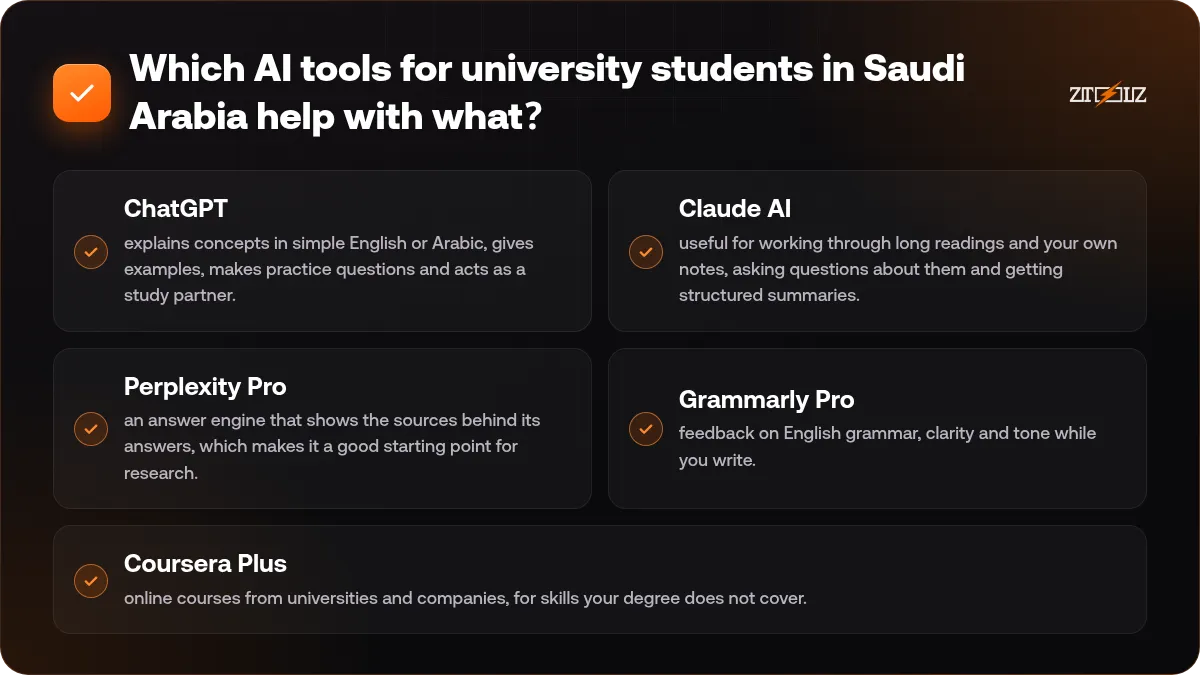
- ChatGPT: explains concepts in simple English or Arabic, gives examples, makes practice questions and acts as a study partner.
- Claude AI: useful for working through long readings and your own notes, asking questions about them and getting structured summaries.
- Perplexity Pro: an answer engine that shows the sources behind its answers, which makes it a good starting point for research.
- Grammarly Pro: feedback on English grammar, clarity and tone while you write.
- Coursera Plus: online courses from universities and companies, for skills your degree does not cover.
If you want a wider comparison, see our list of the best AI tools for students.
How can AI help you understand lectures in two languages?
A common problem: the lecture is in English, the slides are dense, and the terms are new. Here is a routine that works:
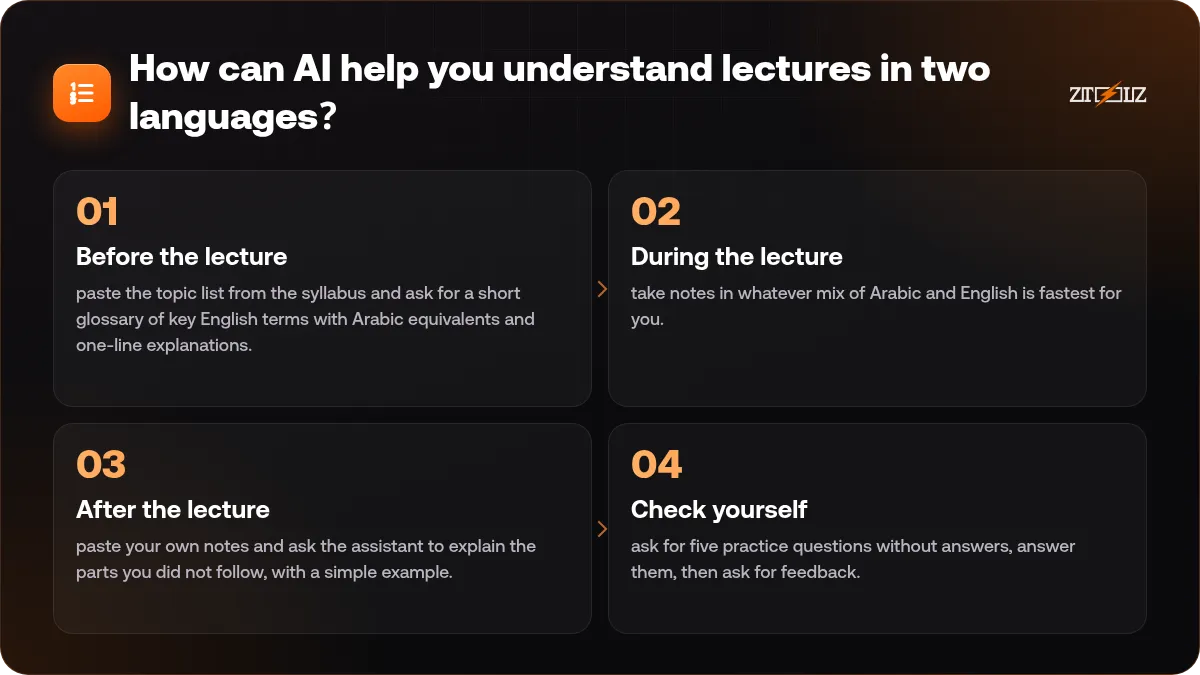
- Before the lecture: paste the topic list from the syllabus and ask for a short glossary of key English terms with Arabic equivalents and one-line explanations.
- During the lecture: take notes in whatever mix of Arabic and English is fastest for you. Do not record unless your instructor allows it.
- After the lecture: paste your own notes and ask the assistant to explain the parts you did not follow, with a simple example.
- Check yourself: ask for five practice questions without answers, answer them, then ask for feedback.
A prompt you can adapt: "I am a second-year pharmacy student. Explain first-pass metabolism in simple English, then in Arabic, with one everyday example. Then ask me three questions to check I understood."
Remember that AI can be wrong, especially on detailed technical points. Check anything important against your lecture slides and textbook. For more methods, read how to summarise lectures and study with AI.
How do you research with real, checkable sources?
The biggest risk with AI in research is invented references: titles, authors or page numbers that do not exist. Protect yourself with a simple rule: a source does not count until you have opened it yourself.
- Use Perplexity Pro to map a topic and find starting points, then open every linked source.
- Move to your university library's databases for academic papers. Your librarians can show you how to search them.
- Read the abstract and conclusion of each paper yourself before citing it.
- Use the citation style your department asks for, and check each citation by hand.
- Keep a simple research log: what you searched, what you found, what you used.
Our guide to research with sources in Perplexity goes further into search techniques.
How do you improve your English academic writing without losing your voice?
Your goal is to become a better writer, not to hand in a polished text you could not have written. That changes how you use the tools:
- Write the first draft yourself, even if the English is not perfect.
- Run it through Grammarly Pro and read each suggestion. Accept the ones you understand, and ignore any that change your meaning.
- Ask ChatGPT or Claude to explain your three most repeated mistakes rather than rewrite the paragraph.
- Keep a personal error list (articles, prepositions, long sentences) and check for those first in every new assignment.
- Read the final version aloud. If a sentence does not sound like you, simplify it.
For Arabic assignments, AI assistants can point out possible errors, but always have the final text checked by you or a fluent reader.
How can you practise presentations and oral exams with AI?
Presentations are a big part of many Gulf programmes, often in English. AI makes a patient rehearsal partner:
- Share your outline and ask for the three weakest points in your argument.
- Ask the assistant to act as a strict examiner and question you on your topic, one question at a time.
- Practise saying technical terms aloud and ask for simpler ways to explain them.
- Time yourself and cut anything that runs over.
Which extra skills should you learn alongside your degree?
Employers in Riyadh, Dubai and Doha often look for practical skills on top of the degree: spreadsheets, data analysis, basic programming, project management, design or digital marketing. Coursera Plus gives you structured courses in these areas.
Pick one skill per semester and finish one small project with it, such as a dashboard of public data or a simple website. A project you can show in an interview often says more than a list of courses.
A weekly study workflow with AI
- Start of the week: plan the week's readings and deadlines. Ask an assistant to turn them into a realistic daily plan.
- After each lecture: 20 minutes of notes review and self-quiz.
- Midweek: research session with sources, logged as you go.
- Writing days: draft first, then feedback, then your own revision.
- End of the week: one hour on your extra skill course, and a short review of what you learned.
Privacy and shared account habits
Do not paste your student ID, grades, classmates' names or unpublished research data into any AI tool. If you use tools through a shared account, also avoid changing settings or saving personal files there. Read security habits for shared platform accounts for a quick checklist.
Study tools in one place. ZTOOLZ gives students shared access to ChatGPT, Claude AI, Perplexity Pro, Grammarly Pro and Coursera Plus through accounts owned by the platform, opened with the Chrome extension, the secure browser or a cloud version. Pick only the tools you need with the + button in the store to build one custom plan. Prices appear in your local currency on each tool page.
FAQ
Is using ChatGPT for university work cheating?
It depends on how you use it and on your course policy. Using it to explain topics or quiz yourself is usually treated very differently from submitting AI-written text, which is not acceptable. Always check your course rules.
Which AI tool is best for finding sources?
Perplexity Pro shows the sources behind its answers, which makes it a good first step. You still need to open and read every source and use your university library for academic papers.
Does Grammarly work with Arabic?
Grammarly is built for English writing. For Arabic texts, an AI assistant can point out possible errors, but you or a fluent reader should check the final version.
Can AI write my assignment for me?
It should not. Submitting AI-written work as your own breaks academic integrity rules at most universities. Use AI for understanding, practice and feedback, and do the writing yourself.
Do I need all five tools?
No. Many students start with one assistant such as ChatGPT and add Grammarly Pro or Perplexity Pro when they have a writing-heavy or research-heavy semester.