Gulf Arabic (Khaleeji) AI Voiceover: Scripts That Sound Local
Gulf Arabic (Khaleeji) AI voiceover for ads and Snapchat: dialect scripts, spelling words so voices read them right, when MSA is safer, and local testing.
A Gulf Arabic (Khaleeji) AI voiceover can work for local ads, Snapchat and TikTok videos and store promos, but only if you write the script the way Gulf people actually speak and test it with a native listener. Dialect quality differs a lot between tools and between individual voices, so treat every voice as a candidate to test, not a promise. This guide covers how to write Khaleeji scripts, how to spell dialect words so AI voices read them correctly, when Modern Standard Arabic is the safer choice, and how to keep a Gulf brand tone.
What makes Gulf Arabic (Khaleeji) AI voiceover different?
"Gulf Arabic" is a family of dialects, not one accent. Saudi speech alone varies between regions such as Najd and the Hijaz, and Emirati, Kuwaiti, Qatari, Bahraini and Omani speech each have their own words and rhythm. A viewer in Riyadh and a viewer in Kuwait City will both notice quickly if a voice sounds like it comes from somewhere else.
Most AI voices are strongest in Modern Standard Arabic (MSA), and their dialect ability depends on the voice. Some sound convincingly local on short, simple lines; others drift towards MSA, towards another region, or mispronounce everyday Gulf words. You will only know by testing your own script. For general MSA basics and an Egyptian-dialect walkthrough, see our guide to Arabic voiceover with ElevenLabs; this article focuses on the Gulf.
When is MSA safer for a Gulf audience?
Dialect feels warm, but it is not always the right call. MSA is usually the safer choice for:
- Campaigns that run in several Gulf countries at once, where one dialect could feel foreign to the others.
- Corporate, finance, healthcare and government-related content, where a formal tone builds trust.
- E-learning, product tutorials and explainers that people may replay and study.
- Any project where no voice sounds right in dialect after testing.
Dialect tends to fit better in Snapchat and TikTok content, local restaurant and café promos, event invitations, and casual store ads aimed at one country. A useful middle path is a light, widely understood Gulf style, sometimes called a "white" dialect: simple everyday words without heavy local slang. Another option is an MSA voice with a few Gulf words in the on-screen text, which keeps the audio clean while the visuals feel local.
Writing Khaleeji scripts for ads, Snapchat and TikTok
Gulf social content is short, direct and conversational. Write it as if you were sending a voice note to a friend, then tidy it up:
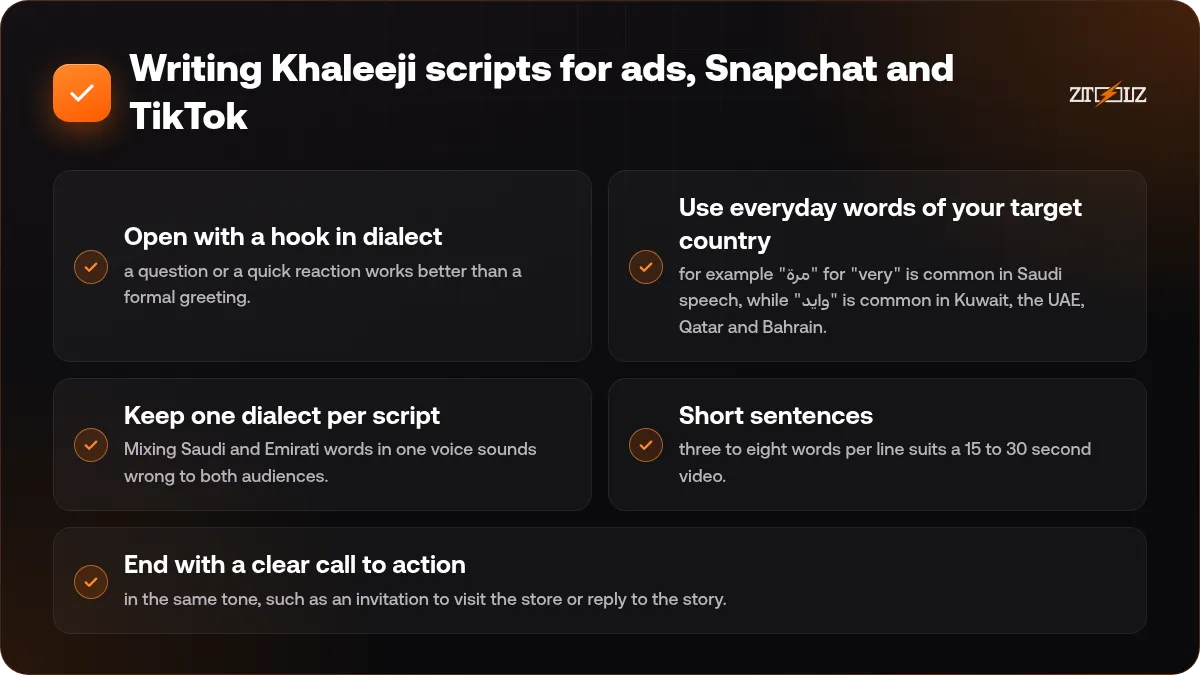
- Open with a hook in dialect: a question or a quick reaction works better than a formal greeting.
- Use everyday words of your target country: for example "مرة" for "very" is common in Saudi speech, while "وايد" is common in Kuwait, the UAE, Qatar and Bahrain. "وش" for "what" sounds Saudi; "شلون" sounds Kuwaiti.
- Keep one dialect per script. Mixing Saudi and Emirati words in one voice sounds wrong to both audiences.
- Short sentences: three to eight words per line suits a 15 to 30 second video.
- End with a clear call to action in the same tone, such as an invitation to visit the store or reply to the story.
Example for a Saudi café promo: "تبي قهوة تضبط يومك؟ جرّب مزيجنا الجديد، والحين بسعر الافتتاح. حياك." The same idea for an Emirati audience might swap in words like "شحالكم" for the greeting and "وايد" for emphasis. Have a local writer adjust the wording rather than guessing.
Write the script as people say it, not as they would write a formal letter. If a line sounds odd when you say it out loud in dialect, the AI voice will sound odd too.
How to write Gulf dialect words so AI voices read them correctly
Gulf pronunciation often differs from the spelling. In many Gulf dialects the letter ق is pronounced close to a hard "g", and in some, ك can sound like "ch" in certain words. AI voices usually read the standard letter, so you may need to adjust spelling and test:
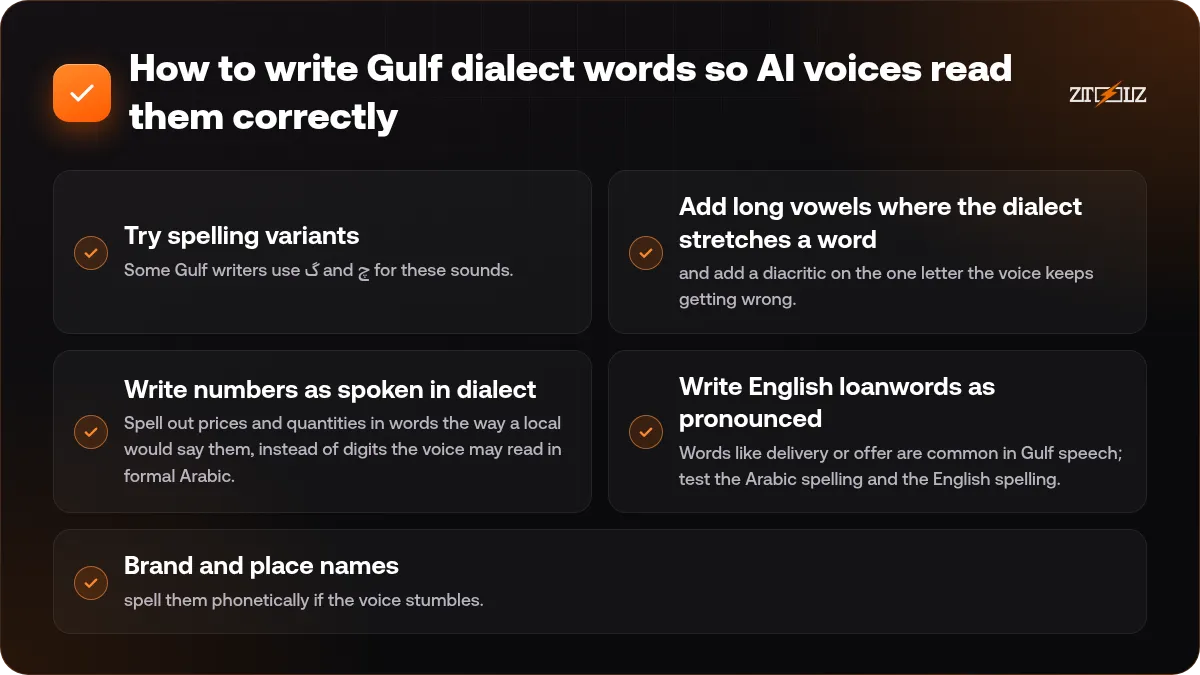
- Try spelling variants. Some Gulf writers use گ and چ for these sounds. Some voices read them as intended, others do not; generate both versions and keep the one that sounds right.
- Add long vowels where the dialect stretches a word, and add a diacritic on the one letter the voice keeps getting wrong.
- Write numbers as spoken in dialect. Spell out prices and quantities in words the way a local would say them, instead of digits the voice may read in formal Arabic.
- Write English loanwords as pronounced. Words like delivery or offer are common in Gulf speech; test the Arabic spelling and the English spelling.
- Brand and place names: spell them phonetically if the voice stumbles.
Keep a pronunciation sheet for your brand with each tricky word and the spelling that worked. It saves time on every future script and keeps all your ads consistent.
Testing with a native Gulf listener
Your own ear is not enough, especially if you are not from the target country. Make testing a fixed step:
- Generate the real script with three or four voices, plus an MSA version.
- Play them to someone from the exact country you target, without saying which is which.
- Ask simple questions: does this sound local? Which word sounds wrong? Would you trust this ad?
- Fix the flagged words and regenerate only those lines.
- Do a final listen on a phone speaker, the way most people hear Snapchat and TikTok.
If the listener hesitates or smiles in the wrong place, take it seriously. A slightly wrong dialect often feels worse to locals than clear MSA.
Keeping a Gulf brand tone
Tone matters as much as words. Gulf audiences generally respond well to warmth, hospitality and respect. Phrases of welcome feel natural, while pushy sales language can feel cheap.
- Match the tone to the occasion: calmer and more reflective for Ramadan, proud and celebratory for National Day, light and fun for weekend offers.
- Avoid exaggerated slang or imitating a dialect for comedy; it can come across as mocking.
- Be careful with religious phrases. Use them naturally and respectfully, never as a gimmick.
- Keep the same voice across your ads so customers start to recognise your brand.
Choosing a voice tool and finishing the audio
Test the same Gulf script in more than one tool, because dialect quality varies by voice more than by brand. ElevenLabs offers expressive multilingual voices, and regenerating a line a few times is normal. Voicemaker lets you adjust speed and pitch and insert pauses, which helps you fit tight ad timings. Revoicer offers simple text-to-speech with different voice styles for short promos. For more options, read ElevenLabs alternatives.
When mixing, keep the voice clearly louder than the music, lower the music under speech, and choose tracks without lyrics. Use music from a licensed source and check its terms for your project. Our guide to video ads for small businesses covers the rest of the ad.
When is a human Gulf voice actor the better choice?
Book a native voice actor for big brand campaigns, TV and radio, emotional storytelling, humour, and any script with heavy local dialect where a small slip would hurt trust. Only clone a voice you own or have clear written permission to use, and check each platform's rules on labelling AI-generated content and each tool's terms for commercial use.
Voice tools through ZTOOLZ: ZTOOLZ offers shared access to ElevenLabs, Voicemaker and Revoicer through accounts owned by the platform, opened with the ZTOOLZ Chrome extension, the secure browser app or a cloud version in the browser, depending on the tool. Since the accounts are shared, avoid uploading private recordings or cloning personal voices there. Take one tool, add several to a custom plan in the store with the + button, or choose an All In One plan on the pricing page. Prices appear in your local currency; see each tool page for the current price.
FAQ
Can AI voices speak Khaleeji naturally?
Some voices handle simple Gulf lines reasonably well, but quality varies by tool and voice. Test your real script and have a native listener from your target country check it before publishing.
Should I use Saudi or Emirati dialect for a Gulf-wide campaign?
Neither, usually. For several countries at once, clear MSA or a light, neutral Gulf style is safer. Save a specific dialect for content aimed at one country.
Should I write ق as گ in my script?
Try both. Some voices read the alternative letters as intended and others do not. Keep whichever spelling sounds right in the generated audio.
Is MSA too formal for Snapchat?
Not if the script is short and friendly. Simple MSA with dialect words in the on-screen text often works well and avoids a dialect that sounds wrong.
Can I use an AI Gulf voice in paid ads?
Many advertisers do, but check the voice tool's terms for commercial use and the ad platform's rules on AI-generated content, since both can change.