Marketing Tools for Salla and Zid Online Stores: A Practical Kit
Marketing tools for Salla and Zid online stores: product mockups, packaging previews, ad designs, Arabic keywords, competitor research and a monthly routine.
The most useful marketing tools for Salla and Zid online stores are the ones that fill the gaps the platform leaves: strong product visuals, ad designs that fit each channel, the Arabic words shoppers actually type, and a clear view of what competitors do. This guide covers each job with a practical method, the tools that speed it up, and a monthly routine you can run whether your customers are in Riyadh, Jeddah, Kuwait City or Dubai.
One note first: Salla and Zid run your store, while the tools below work on their own, outside your dashboard. ZTOOLZ is not connected to Salla or Zid and never accesses your store. You create content in these tools and upload the results yourself, the same way you would on Shopify.
What does a Salla or Zid store need beyond the platform?
Store platforms handle the catalogue, checkout, shipping and orders. They cannot make someone stop scrolling on Snapchat, or choose the words in a product title. That work falls into five areas:
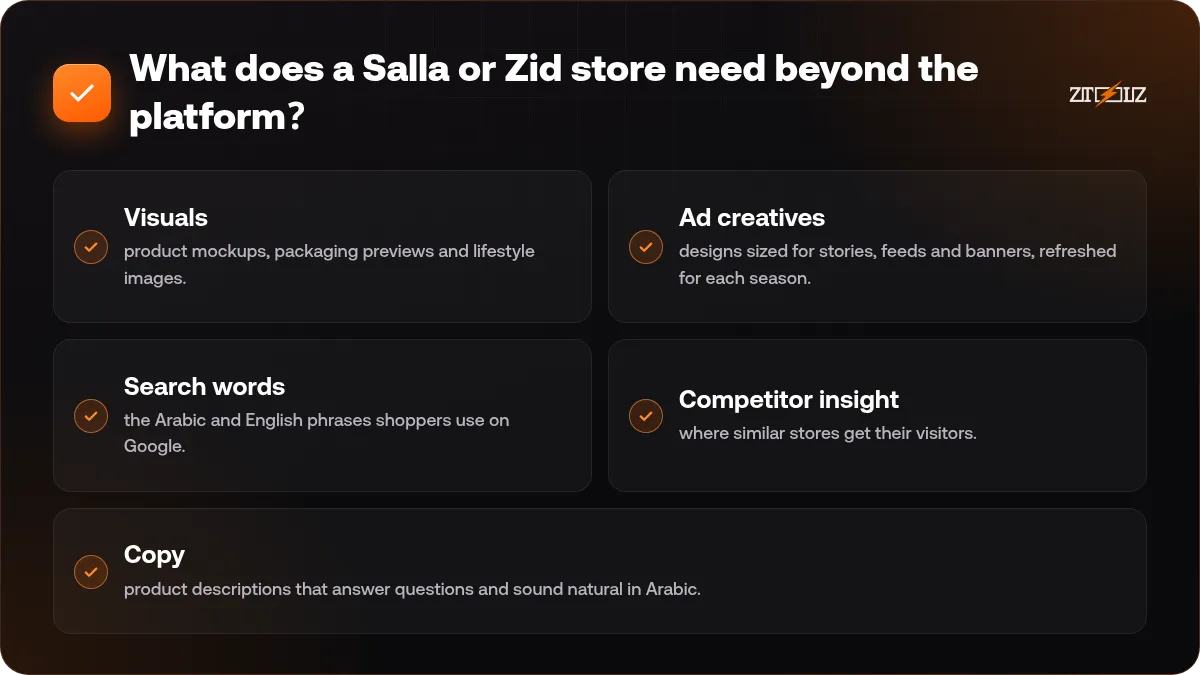
- Visuals: product mockups, packaging previews and lifestyle images.
- Ad creatives: designs sized for stories, feeds and banners, refreshed for each season.
- Search words: the Arabic and English phrases shoppers use on Google.
- Competitor insight: where similar stores get their visitors.
- Copy: product descriptions that answer questions and sound natural in Arabic.
You do not need every tool at once. If your product pages look plain, begin with visuals. If you get visitors but few orders, fix your copy and keywords first.
How do you make product mockups and packaging previews?
A mockup places your design on a realistic object such as a T-shirt, mug or phone screen. It is ideal for print-on-demand stores and for testing a new design before you order stock.
Placeit has a large library of ready mockup templates, plus templates for logos, social posts and short promo videos. A simple workflow:
- Export your design as a PNG with a transparent background.
- Search Placeit for the product type and pick a scene that suits your audience: modest fashion, office, outdoors or home.
- Upload the design, adjust the colour of the item and download several angles.
- Use one clean mockup as a product image and keep the lifestyle scenes for ads.
If you sell perfume, sweets, dates, cosmetics or gift boxes, packaging matters almost as much as the product. Pacdora lets you place your artwork on 3D box, bag and bottle templates and preview them from different angles. You can show customers a realistic box before launch and check that the design fits the shape. Always confirm final measurements with your printer, because every supplier works with its own dieline.
Keep mockups honest. If the image shows a gold foil box, the customer should receive a gold foil box. Mockups are for presentation, not for promising a finish you do not offer.
Designing social ad creatives that fit each channel
Gulf shoppers spend a lot of time on Snapchat, Instagram, TikTok and X. A vertical story, a square post and a wide banner each need their own layout.
Canva Pro is the practical choice for most store owners. Set up a Brand Kit once with your logo, colours and fonts, then use the resize feature to turn one design into several formats. Tips that work well for store ads:
- One product, one message and one offer per design. A crowded ad reads as noise on a phone.
- Keep the Arabic headline large and short, ideally under six words, and check that the font joins the letters correctly.
- Keep text away from the top and bottom edges of vertical stories, where app buttons cover the screen.
- Prepare seasonal sets early: Ramadan, Eid al-Fitr, Eid al-Adha, Saudi National Day, UAE National Day, back-to-school and the end-of-year sales season that many shoppers in the region call White Friday.
- Make two or three versions of each ad with a different headline or image, so you can see which one performs better.
For more layout ideas, read our guide to designing ad creatives.
Keyword research for Arabic store SEO
Search traffic is slow to build but cheap to keep. The aim is to use the words shoppers type in your product names, descriptions, category pages and page titles. Salla and Zid both give you fields for these; check your dashboard to see what your plan offers.
Arabic keyword research has its own challenges. The same product may be searched in several ways: with or without the definite article, singular or plural, Gulf or Egyptian wording, Arabic or English (for example "عطر عود" and "oud perfume"). Some shoppers type the hamza and some do not. Mangools includes KWFinder, where you choose a country and language, see estimated search volume and difficulty, and discover related phrases.
- List 10 to 20 seed words for your products in Arabic and English.
- Run each one with the location set to Saudi Arabia, the UAE or your main market.
- Group related phrases and choose one main phrase per page. Avoid targeting the same main phrase on many pages.
- As a new store, prefer specific phrases with lower difficulty, such as a style and colour of abaya, rather than a broad word like "abayas".
- Use the main phrase naturally in the product name, the first lines of the description and the image file names.
Search numbers are estimates, and Arabic long-tail phrases often show small volumes even when they bring buyers. Our article on SEO writing with AI shows how to turn keywords into genuinely helpful pages.
How can you study competitor traffic?
Similarweb estimates how many visits a website gets and where they come from: search, social media, direct visits, referrals and ads. For a store owner, that answers practical questions:
- Which social network sends most visitors to a competitor? Your audience is probably there too.
- Which sites send them traffic? Influencer pages, coupon sites and blogs can become your partners.
- Is their traffic seasonal? A jump every Ramadan tells you when to start your own campaigns.
The figures are estimates built from samples, so they are more reliable for larger sites, and a small new store may show little or no data. Compare trends and shares rather than exact visit counts: the goal is to learn where to spend your time, not to copy anyone.
Writing Arabic product descriptions with AI
AI assistants such as ChatGPT can draft descriptions quickly, but a vague prompt gives vague text. Give the assistant real details and a clear structure. For example:
Write an Arabic product description for an online store in Saudi Arabia. Product: oud perfume, 50 ml, in a black gift box. Tone: warm, clear Modern Standard Arabic. Structure: a two-line opening about the feel of the scent, then five bullet points (main notes, size, packaging, who it suits, how to use it), then one short line about delivery. Do not invent any claims I have not given you.
Then edit it as a human would:
- Check every fact against the real product and remove anything you cannot back up, such as health claims.
- Read it aloud. If a sentence sounds translated, rewrite it.
- Add answers to the questions customers ask you in chat: size, ingredients, care and returns.
- Write a unique description for each product instead of one template with the name changed.
For more on Arabic quality, see Arabic content quality with AI.
A simple monthly marketing routine for your store
This routine fits into a few hours a week:
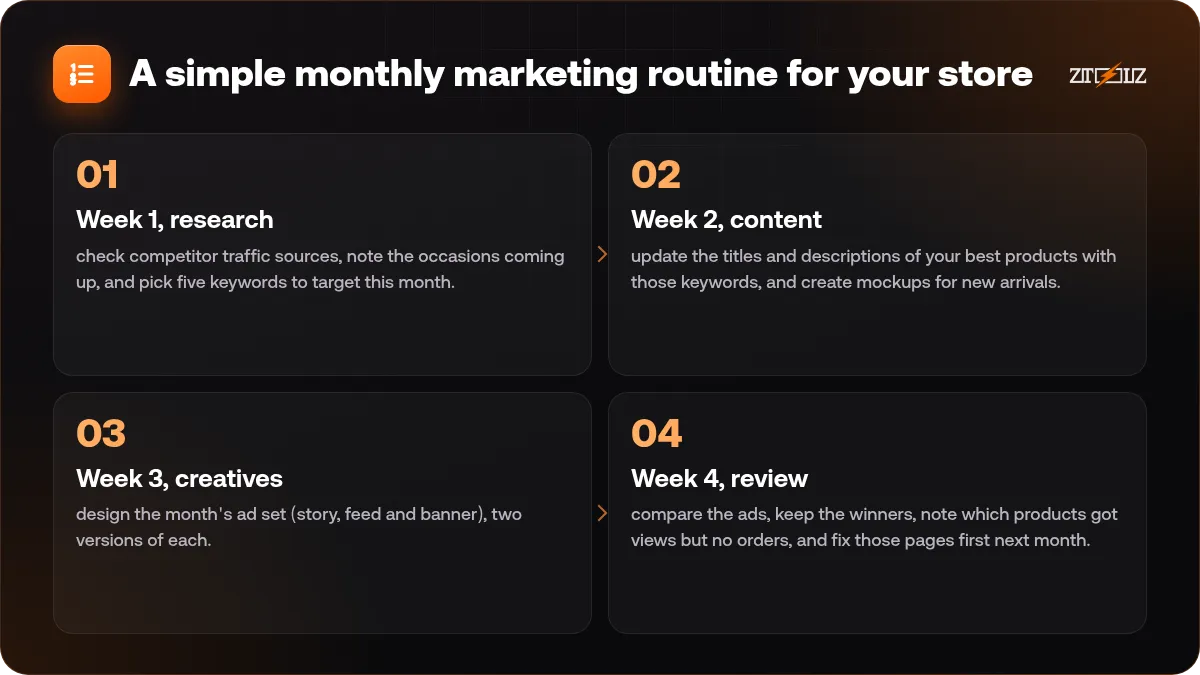
- Week 1, research: check competitor traffic sources, note the occasions coming up, and pick five keywords to target this month.
- Week 2, content: update the titles and descriptions of your best products with those keywords, and create mockups for new arrivals.
- Week 3, creatives: design the month's ad set (story, feed and banner), two versions of each.
- Week 4, review: compare the ads, keep the winners, note which products got views but no orders, and fix those pages first next month.
Plan seasonal campaigns at least a month ahead. Ramadan designs, for example, are best finished before the month begins, because competition for attention usually grows during busy seasons.
Common mistakes to avoid
- Copying competitor descriptions word for word. It hurts trust and search visibility.
- Chasing high-volume keywords a new store cannot rank for yet.
- Saving customer lists or private files inside shared design accounts. Keep personal data in your own store dashboard. Our habits for using shared accounts safely explain more.
- Promising delivery times or product details in ads that your store pages do not match.
Getting these tools through ZTOOLZ: ZTOOLZ offers shared access to Placeit, Pacdora, Canva Pro, Mangools and Similarweb through accounts owned by the platform. Depending on the tool, you open it with the ZTOOLZ Chrome extension, the secure browser app or a cloud version in your browser. Take a single tool, build a custom plan in the store by adding tools with the + button, or choose an All In One plan on the pricing page. Prices appear in your local currency; see each tool page for the current price.
FAQ
Is ZTOOLZ connected to Salla or Zid?
No. ZTOOLZ gives access to design and research tools only. You create images, keywords and copy there and add them to your store yourself.
Which tool should a new store start with?
Usually a design tool such as Canva Pro, since you need visuals from day one. Add keyword research once product pages are ready, and competitor research before paid campaigns.
Can I write product descriptions in Gulf dialect?
You can, especially in social ads, but many stores keep product pages in clear Modern Standard Arabic so every Arab shopper understands them. A light Gulf touch in headlines can work well, so test both styles with your audience.
Are Similarweb figures exact?
No, they are estimates. Use them to compare trends and traffic sources rather than as precise visit counts, especially for small or new stores.
Do I need mockups if I already take product photos?
Not always. Mockups are most useful for print-on-demand, packaging previews before production and quick ad visuals. Real photos of the actual product remain the best main images for your store.