CV for Jobs in Saudi Arabia and the UAE: What Gulf Recruiters Expect
A CV for jobs in Saudi Arabia and the UAE: the format Gulf recruiters expect, Arabic and English versions, tailoring to job ads, LinkedIn and interview prep with AI.
A strong CV for jobs in Saudi Arabia and the UAE follows a format that Gulf recruiters can scan in seconds, comes in English and often in Arabic too, and is tailored to each job ad. AI tools such as ChatGPT and Claude make the tailoring and the bilingual version much faster, as long as every fact comes from you. This guide focuses on the Gulf job market: what recruiters in Riyadh, Jeddah, Dubai, Abu Dhabi, Doha and Kuwait City look for, and how to adapt your CV, LinkedIn profile and interview answers. For the general basics of writing a CV with AI, start with our guide to writing a CV and job emails with AI.
What do recruiters expect in a CV for jobs in Saudi Arabia and the UAE?
Recruiters and hiring managers in the region often receive a large number of applications for one role, many through online portals and recruitment agencies. A predictable structure helps them find what they need quickly:
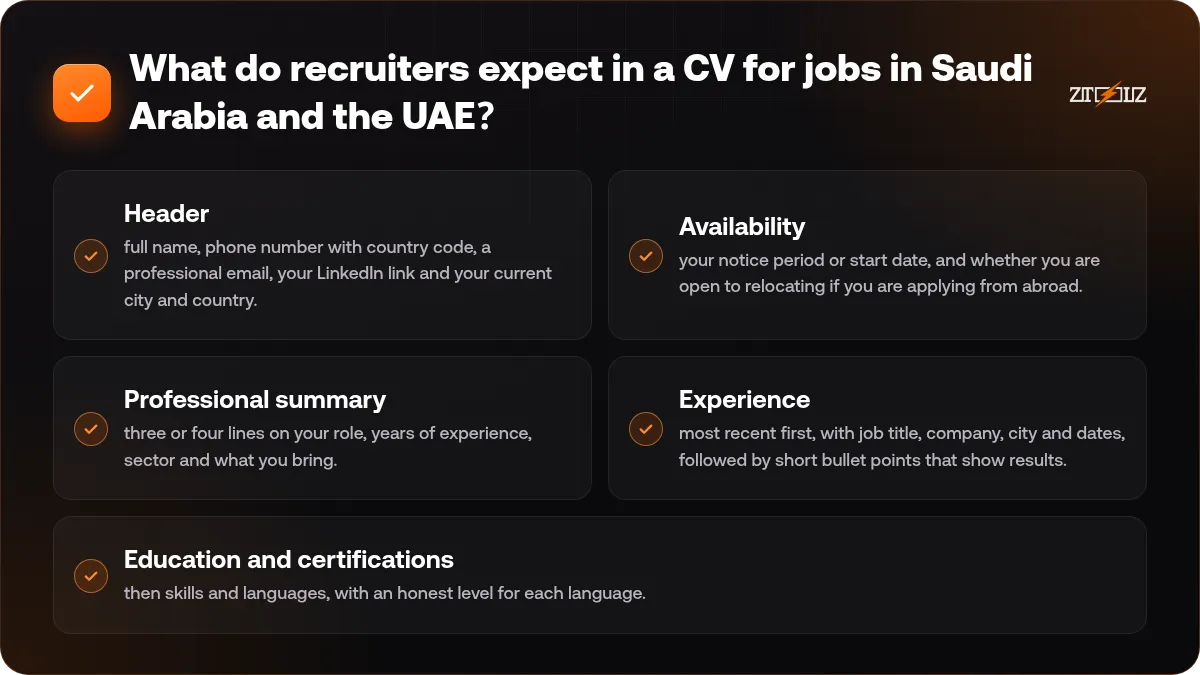
- Header: full name, phone number with country code, a professional email, your LinkedIn link and your current city and country.
- Availability: your notice period or start date, and whether you are open to relocating if you are applying from abroad. Recruiters ask about this early, so stating it saves a step.
- Professional summary: three or four lines on your role, years of experience, sector and what you bring.
- Experience: most recent first, with job title, company, city and dates, followed by short bullet points that show results.
- Education and certifications, then skills and languages, with an honest level for each language.
One to two pages is usual. A photo is common in the region but not required, so follow the ad or the company's usual practice. Include any other personal details only when the job ad asks for them.
Do you need an Arabic CV, an English CV or both?
English is the working language in much of the private sector, especially in the UAE, Qatar and multinational companies across the Gulf. An Arabic version is valuable for government and semi-government roles, many Saudi employers and any position where Arabic communication is central. If you speak both languages well, prepare both and send the one that matches the ad's language.
- Write, do not translate. Ask the AI to produce a natural Arabic CV from your English one, then review job titles and terms yourself. Literal translation reads badly to Arabic-speaking recruiters.
- Keep your name consistent. Use the same English spelling as in your official documents on every version and on LinkedIn.
- Check right-to-left layout. Make sure Arabic text is right-aligned and that dates and numbers display correctly in the final PDF.
- Show your languages clearly. Being bilingual is an advantage in many Gulf roles, so list Arabic and English with honest levels near the top of your skills.
Claude and ChatGPT both handle Arabic well, though their styles differ; our comparison of ChatGPT vs Claude vs Gemini can help you pick one.
How do you tailor your CV to Gulf job ads?
Gulf job ads tend to list clear requirements: a degree, years of experience, a specific sector, certain software or certifications, language skills and sometimes experience in the region. Recruiters often filter on exactly these points, so your CV should answer them directly.
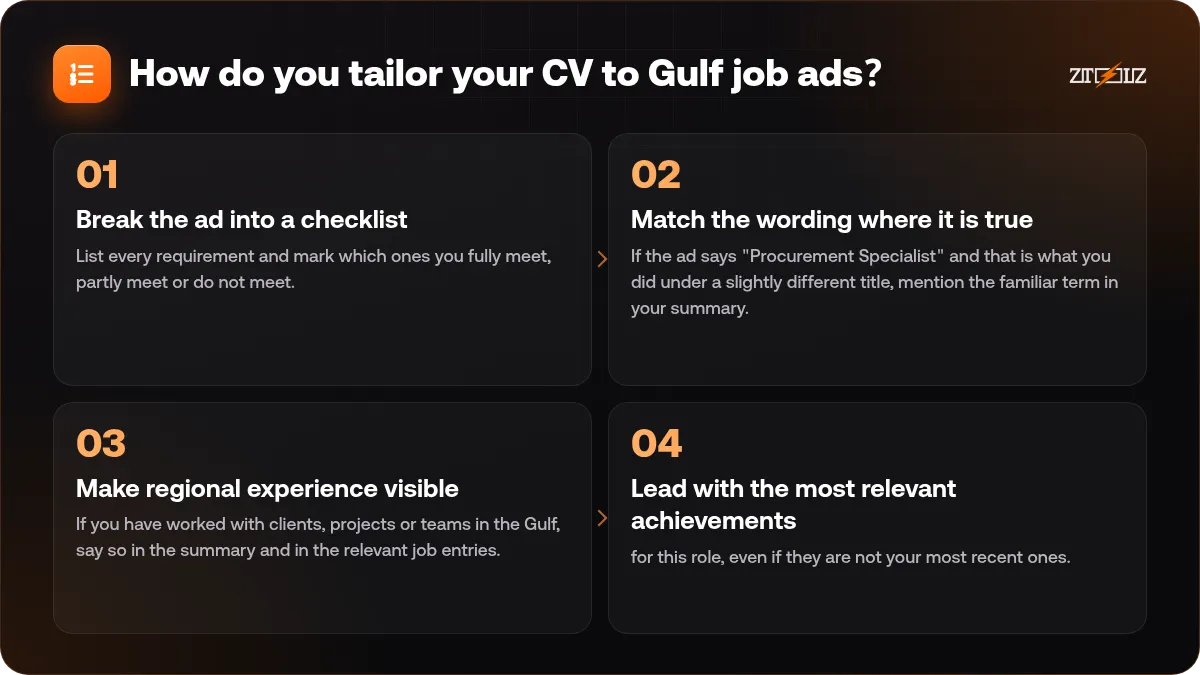
- Break the ad into a checklist. List every requirement and mark which ones you fully meet, partly meet or do not meet.
- Match the wording where it is true. If the ad says "Procurement Specialist" and that is what you did under a slightly different title, mention the familiar term in your summary.
- Make regional experience visible. If you have worked with clients, projects or teams in the Gulf, say so in the summary and in the relevant job entries.
- Lead with the most relevant achievements for this role, even if they are not your most recent ones.
AI makes this fast. Paste the ad and your master CV and ask:
Compare my CV with this job ad. List the requirements I meet, the ones I partly meet and keywords I should add only if they are true for me. Then rewrite my summary for this role in four lines. Do not add any experience, skill or number that is not already in my CV.
AI can quietly add skills or numbers you never had. Read every line and ask yourself whether you could explain it in an interview. Before pasting, remove ID or passport numbers and your full address: the AI only needs your experience.
Formatting for job portals and recruitment agencies
Many large employers and agencies in the region use applicant tracking systems that read your file before a person does. Keep the version you upload simple:
- One column, standard headings (Experience, Education, Skills) and a common font.
- No tables, text boxes, icons in place of contact details, or text inside images.
- The file type the ad requests, usually PDF or Word, with a clear file name such as "Firstname-Lastname-CV.pdf".
- Consistent dates, full job titles and one spelling style throughout. Grammarly helps catch grammar and tone problems in the English version.
A designed CV made in Canva Pro works well when you email a hiring manager directly or meet employers at a career fair. Keep the plain version for portals, and check that the text in your PDF can be selected and copied.
LinkedIn for the Gulf job market
Recruiters across the Gulf use LinkedIn heavily to search for candidates, so your profile is often seen before your CV:
- Headline: combine your title, specialism and city, for example "Procurement Specialist | Oil and Gas | Riyadh". If you are relocating, say so only when it is a real plan.
- About section: ask the AI for a first-person summary of about 150 words using the same facts as your CV, then edit it in your own voice.
- Second language profile: LinkedIn lets you add a version of your profile in another language, which is useful if you want an Arabic profile alongside the English one.
- Skills and learning: add the skills from your target ads, and complete short courses that close real gaps. LinkedIn Learning covers interviewing, Excel, project management and many professional topics, and finished courses can be shown on your profile.
- Consistency: dates and job titles must match your CV exactly.
A short cover letter for Gulf applications
When you apply by email or through a recruiter, a brief cover letter still helps. Keep it to three paragraphs: why this company and role, the two or three achievements most relevant to the ad, and your availability or notice period. Ask the AI for a draft from your tailored CV, then remove anything that sounds like a template.
Preparing for interviews with Gulf employers
Interviews are often a mix of phone screening, a video call and a final meeting. Paste the job ad into the assistant and ask it to interview you:
You are a recruiter in Dubai interviewing me for this role. Ask one question at a time, wait for my answer, then give short feedback on clarity and structure using the STAR method (situation, task, action, result).
Prepare for questions that come up often in the region: "Why do you want to work in Saudi Arabia or the UAE?", "What do you know about our company and its projects?", "What is your notice period?", "Are you open to relocating?" and "Describe working in a multicultural team." For salary questions, research the market for your role through reliable sources and recruiters, and practise answering calmly with a range you can justify.
Mistakes to avoid
- Sending one generic CV to every Gulf employer without tailoring the summary and keywords.
- A literal Arabic translation that reads awkwardly.
- Different dates or titles on your CV and LinkedIn.
- Over-designed layouts that portals cannot read.
- Leaving out your location and availability when you apply from abroad.
- Copying AI text without checking it, or leaving personal data inside AI chats.
Want these tools for your Gulf job search? ZTOOLZ offers shared access to ChatGPT, Claude AI, Grammarly, LinkedIn Learning and Canva Pro through accounts owned by the platform, opened with the ZTOOLZ Chrome extension, the secure browser app or a cloud version in the browser. Because the accounts are shared, keep personal data out of them and delete chats you no longer need; our shared account security habits guide explains how. Combine the tools you need in one custom plan with the + button in the store, with prices shown in your local currency.
FAQ
Should I put a photo on my CV for jobs in the Gulf?
A photo is common in the region but not required. Follow the job ad and the employer's practice. If you add one, use a recent professional photo with a plain background, and leave it out of the plain version you upload to portals.
Is an English CV enough for jobs in Saudi Arabia?
For many private-sector and multinational roles, yes. For government, semi-government and Arabic-focused positions, an Arabic version helps. If you speak both languages, prepare both and send the one that matches the ad.
How long should a CV for the Gulf be?
One page for early-career applicants and up to two pages for experienced professionals. Senior or technical roles can justify more detail, but every line should be relevant to the job.
Can recruiters tell if my CV was written with AI?
They often notice generic phrases and claims that do not match the rest of your profile. Use AI to improve wording and tailoring, keep your real facts, and edit the result in your own voice so it holds up in the interview.
Is it safe to paste my CV into ChatGPT or Claude?
Remove identity numbers, your full address and anything private first. Your experience and skills are enough for the AI to work with, and you can add your contact details back in the final document.